



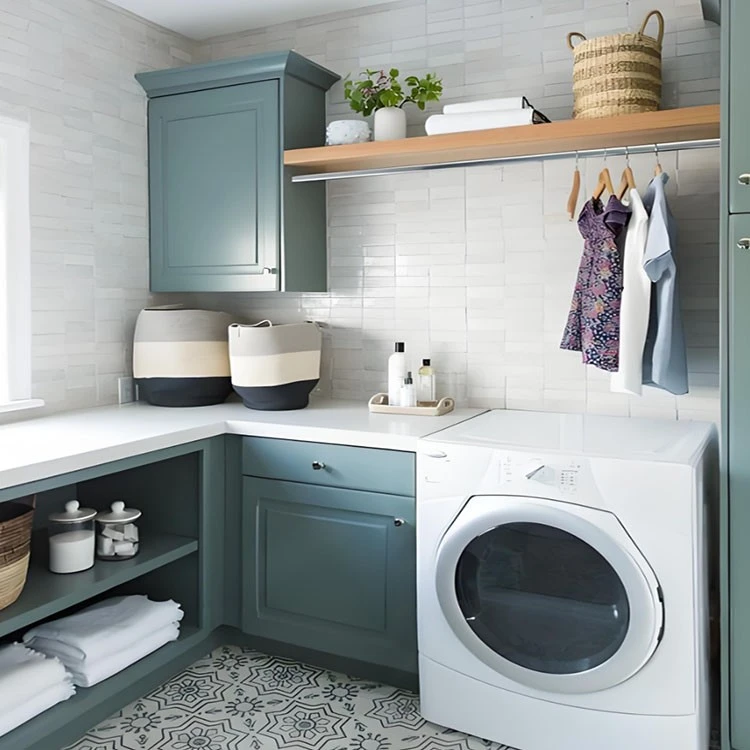

Built In Laundry Room Cabinets
Description
Technical Parameters
built in laundry room cabinets

🛠️ Key Benefits of Built-In Laundry Cabinets
Space Optimization
Utilize vertical space with floor-to-ceiling units for seasonal items or infrequently used supplies .
Fit awkward niches (e.g., under stairs or sloped ceilings) with custom depths (20–26 inches) .
Enhanced Functionality
Integrate pull-out hampers, drying racks, ironing boards, and pet feeding stations .
Dedicate zones for detergents, cleaning tools, and folding areas .
Aesthetic Appeal
Match home decor with finishes like matte gray MDF, turquoise laminate, or natural wood veneers .
Add luxe touches: quartz countertops, brass handles, or shiplap backsplashes .
📐 Planning & Design Considerations
Layout Types
Single-Wall: Ideal for narrow spaces; combine upper/lower cabinets with a countertop over appliances .
L-Shaped/U-Shaped: Maximize storage in larger rooms; include a central folding island .
Ceiling-Height Units: Extend cabinets to the ceiling for bulk storage (e.g., quilts, pet food) .
Critical Measurements
Depth: 22–24 inches for hanging zones; 16–20 inches for shelves/drawers .
Clearance: Leave ≥36 inches in front of appliances for door access .
Ventilation: Add mesh backs or gaps behind cabinets to prevent moisture buildup .
🌿 Material & Durability Guide
| Material | Best For | Pros & Cons |
|---|---|---|
| Plywood/MDF | Budget-friendly builds | Affordable; paintable. Avoid in humid areas unless sealed . |
| Aluminum Alloy | Humid climates | Rust-proof, scratch-resistant; sleek finishes (brushed silver, matte black) . |
| Marine Plywood | High-moisture areas | Water-resistant; ideal for sinks or leak-prone zones . |
| Melamine Laminate | Easy maintenance | Wipe-clean surface; variety of colors/patterns . |
💡 Eco-Tip: Opt for E0/E1-grade boards (formaldehyde ≤0.025mg/L) for indoor air safety .
🧺 Smart Storage Features
Concealed Solutions
Pull-Out Hampers: Hide dirty laundry in tilt-out bins or fabric baskets (e.g., VASAGLE's removable hamper) .
Tip-Out Trays: Store detergent pods or scrub brushes under sinks .
Specialized Organizers
Adjustable shelves (3cm-spaced peg holes) for varying item heights .
Dedicated zones: ironing stations, pet-food drawers, or trash/recycling bins .
Multi-Functional Add-Ons
Countertops over washers/dryers for folding (e.g., quartz or granite) .
Retractable clotheslines or ceiling-mounted drying racks .
⚙️ Installation & Professional Support
DIY Steps
Prep Space: Clear walls, locate studs, and repair imperfections.
Secure Frame: Attach cabinets to studs using ledger boards for upper units.
Align Doors/Drawers: Ensure gaps are even; test soft-close hinges (e.g., Blum).
Anchor Safely: Install anti-tip kits to prevent tipping (included with brands like VASAGLE) .
When to Hire Pros
Complex builds: Sloped ceilings, electrical wiring for LED lighting, or plumbing modifications .
Companies like Copper Canyon (Phoenix) offer end-to-end design/installation .
💎 Top Recommendations
By Need
| Scenario | Solution | Example |
|---|---|---|
| Small Spaces | Narrow-depth (18") cabinets + pull-out hampers | VASAGLE's 15.8"W × 31.5"H unit . |
| High Humidity | Aluminum alloy cabinets | Imagery Cabinet's corrosion-resistant models . |
| Luxury Built-Ins | Custom melamine finishes + quartz tops | Geromin's COMP. STO 01 system . |
| Eco-Friendly | E0-grade MDF with water-repellent lining | VASAGLE Dove Gray cabinet . |
Supplier Spotlight
Copper Canyon (Phoenix): Custom pet-feeding stations and hamper integrations .
Geromin: Wheeled laundry baskets and modular components .
VASAGLE: Space-saving cabinets with magnetic-door hampers .
⚠️ Pitfalls to Avoid
Ignoring Moisture: Unsealed MDF swells in humidity-choose marine ply or aluminum .
Inadequate Support: Anchor to studs; avoid overloading shelves (max 44 lbs for VASAGLE) .
Poor Workflow: Place detergent storage near appliances; hampers near sorting zones .
✅ Final Tip: For complex projects, leverage free CAD designs from suppliers like MINO or consult local experts (e.g., Airtasker). Built-ins boost home value while streamlining chores-prioritize depth, durability, and daily ergonomics!
custom laundry cabinet

🎨 Design Styles & Aesthetic Options for custom laundry cabinets
Minimalist
Features: Clean lines, handle-less doors, and neutral palettes (e.g., matte white or gray MDF) for a spacious, clutter-free look .
Best for: Small spaces; pairs well with quartz countertops and integrated appliances.
Rustic/Farmhouse
Elements: Distressed wood finishes, shaker-style cabinets (e.g., deep green or turquoise), vintage brass hardware, and shiplap backsplashes .
Add-ons: Heated brick floors, oak floating shelves, and antique lighting .
Industrial
Materials: Metal frames, reclaimed wood, and exposed hardware for an urban edge .
Functionality: Combines durability with open shelving for detergent display.
Hidden/Integrated Systems
Innovations: Concealed pull-out hampers, fold-down ironing boards, and under-sink cabinets with waterproof finishes .
Space-saving: Corner pull-out baskets maximize awkward niches .
⚙️ Functional Storage Solutions
| Feature | Benefits | Implementation |
|---|---|---|
| Adjustable Shelving | Adapt to varying item heights (e.g., detergent bottles, linens) | Peg holes spaced 3cm apart; marine plywood or aluminum alloy frames . |
| Pull-Out Organizers | Easy access to deep cabinets; prevents clutter | Tip-out trays for detergent pods; hanging rods for drip-drying . |
| Multi-Purpose Units | Combine storage with utility tasks | Cabinets with built-in pet-feeding stations, retractable clotheslines, or ironing boards . |
| Mobility Solutions | Flexibility in compact spaces | Slim rolling shelves between appliances; wheel-mounted cabinets . |
🌿 Material Durability & Maintenance
Humid Environments:
Aluminum alloy: Rust-proof, scratch-resistant; ideal for sink areas .
Marine plywood: Water-resistant; handles leaks better than MDF .
Eco-Friendly Choices:
E0/E1-grade MDF: Low formaldehyde (<0.025mg/L); sealed edges prevent swelling .
Finishes:
Melamine laminate (wipe-clean surface) or wood veneers for warmth .
📏 Installation & Customization Tips
Space Planning:
Depth: 22–24" for hanging zones; 16–20" for shelves/drawers .
Clearance: ≥36" in front of appliances for door access .
Ventilation: Add mesh backs or gaps to prevent mildew .
DIY vs. Professional Installation:
DIY-Friendly: Freestanding units or modular systems (e.g., VASAGLE cabinets with magnetic doors) .
Complex Builds: Hire experts for built-ins involving plumbing, electrical (e.g., under-cabinet lighting), or sloped ceilings .
Hardware Essentials:
Soft-close hinges (e.g., Blum) and full-extension drawer slides .
Anti-tip brackets anchored to wall studs .
💡 Innovative Ideas for Small Spaces
Over-the-Door Cabinets: Utilize vertical space for lightweight supplies .
Ceiling-Height Units: Seasonal storage in bulk-item zones .
Balcony Integration: Hidden cabinets in converted balconies (e.g., fold-down countertops for folding) .
⚠️ Pitfalls to Avoid
Ignoring Moisture: Unsealed MDF warps in humidity-opt for sealed edges or aluminum .
Overloading Shelves: Max load 44 lbs (check manufacturer specs) .
Poor Workflow: Place detergent storage near appliances; hampers near sorting zones .
🏆 Top Suppliers & Cost Guide
| Supplier | Specialty | Price Range |
|---|---|---|
| VASAGLE | Space-saving cabinets with pull-out hampers | 150–400 |
| Geromin | Modular units with wheeled baskets | 300–800+ |
| Copper Canyon | Custom pet stations + quartz countertops | 1,200–5,000+ |
| Mino Cabinet | Rustic handcrafted designs (e.g., shaker cabinets) | 250–700 per linear ft |
✅ Final Tip: For complex layouts, use free CAD tools from brands like MINO or consult designers (e.g., Aniko Nicholson's farmhouse concepts ). Prioritize depth, ergonomics, and climate-resistant materials to create a laundry space that blends luxury with practicality.
how to add cabinets to laundry room
📐 Phase 1: Planning & Preparation for laundry room
Assess Space & Needs:
Measure wall dimensions (height/width/depth) and note obstructions (vents, pipes, windows) .
Plan cabinet layout: Single-wall for narrow spaces, L-shaped for corners, or ceiling-height units for bulk storage .
Inventory laundry essentials (detergents, ironing supplies) to determine shelf/drawer ratios .
Material & Design Selection:
Humid areas: Choose marine plywood, aluminum alloy, or moisture-resistant MDF to prevent warping .
Style options: Minimalist (handle-less doors), rustic (shaker-style), or industrial (metal accents) .
Gather Tools & Safety Gear:
Essential tools: Stud finder, level, drill, screws, ledger board, clamps .
Safety: Anti-tip brackets, goggles, and gloves .
🛠️ Phase 2: Installation Process
Step-by-Step Assembly
Prepare Walls:
Locate wall studs using a stud finder; mark positions for secure anchoring .
Repair wall damage and ensure surfaces are flat .
Install Upper Cabinets First:
Mount a temporary ledger board (leveled) to support cabinets during installation .
Attach cabinets to studs using 3-inch screws; double-check alignment with a level .
Add Lower Cabinets & Countertops:
Secure base cabinets to studs; leave ≥36" clearance in front of appliances .
Install countertops (laminate, quartz) for folding surfaces; add a backsplash to protect walls .
Integrate Hardware & Doors:
Attach doors with soft-close hinges (e.g., Blum) for noise reduction .
Install pull-out drawers or shelves using full-extension slides .
Anchor Securely:
Connect adjacent cabinets for cohesion; use anti-tip brackets on all units .
💡 Phase 3: Functional Customization
Smart Storage Solutions
Vertical space: Add floor-to-ceiling cabinets with adjustable shelves (3cm peg holes) for baskets or linens .
Pull-out features: Slim rolling shelves between appliances, tip-out trays for detergent pods, or fold-down ironing boards .
Corner units: Install revolving shelves or hanging cabinets to utilize awkward spaces .
Aesthetic Upgrades
Lighting: Under-cabinet LED strips for task lighting .
Finishes: High-gloss coatings for modernity, textured wraps for depth, or bold colors (e.g., turquoise) for vibrancy .
Doors: Frosted glass for elegance or magnetic-front cabinets to conceal hampers .
⚠️ Critical Pitfalls to Avoid
Ignoring moisture: Unsealed MDF swells in humidity → Seal edges or use waterproof materials .
Poor workflow: Place detergent storage near appliances; keep hampers accessible for sorting .
Overloading: Adhere to weight limits (typically ≤44 lbs/shelf) .
🔧 Maintenance & Pro Tips
Monthly: Tighten hinges/latches; lubricate slides with silicone spray .
Seasonal: Re-level cabinets if floors shift; reorganize shelves for efficiency .
DIY alternatives: Use tension rod systems or freestanding units for rentals .
💎 Final Tip: For complex builds (e.g., electrical/plumbing integration), consult professionals like Copper Canyon or use free CAD tools from suppliers . Prioritize ergonomics-aim for 40–55" rod heights for hanging and 30–36" countertops for comfortable folding!
how to hang laundry cabinets

📐 Phase 1: Planning & Preparation
Assess Space & Layout:
Measure wall dimensions (height/width/depth) and note obstructions (vents, pipes, windows) .
Plan cabinet placement:
Upper cabinets: Ideal above appliances for detergent storage.
Lower cabinets: Ensure ≥36" clearance in front of appliances for door access .
Sketch a layout to optimize workflow (e.g., detergent storage near washer).
Gather Tools & Materials:
Essential tools: Stud finder, level, drill, screws, ledger board, clamps, measuring tape .
Hardware: Toggle bolts or French cleats (if studs are unavailable), soft-close hinges, anti-tip brackets .
Safety gear: Gloves, goggles.
🔍 Phase 2: Installation Prep
Locate & Verify Studs:
Use a stud finder to detect studs (typically spaced 16–24" apart). Verify by:
Tapping walls for solid sounds.
Checking near electrical outlets/switches (often attached to studs) .
Mark stud centers with a pencil and level .
⚠️ Critical: Scan for hidden pipes/wiring using a stud finder's "metal detection" mode .
Prepare Walls & Cabinets:
Repair wall damage and ensure surfaces are flat .
Pre-assemble cabinets and attach hanging rails or cleats .
🛠️ Phase 3: Hanging Methods
A. Standard Installation (With Studs)
Install Ledger Board:
Mount a temporary ledger board (leveled) to support upper cabinets during hanging .
Secure Cabinets:
Align cabinets with stud marks; drill pilot holes.
Fasten using 3-inch screws into studs .
Connect Multiple Cabinets:
Clamp adjacent cabinets together; secure with screws through face frames .
B. Stud-Free Installation
| Method | Best For | Steps |
|---|---|---|
| Toggle Bolts | Drywall/plaster walls | Drill oversized holes; insert bolts and tighten until wings expand behind wall . |
| French Cleats | Heavy cabinets | Attach angled cleat to wall; mount matching cleat on cabinet for secure interlock . |
| Molly Bolts | Hollow walls | Insert bolts into pre-drilled holes; tighten to expand sleeves against wall . |
💡 Pro Tip: For heavy loads, combine methods (e.g., French cleats + toggle bolts) .
⚙️ Phase 4: Finishing & Safety
Doors & Hardware:
Attach doors using soft-close hinges; adjust gaps for even spacing .
Install pulls/knobs at ergonomic heights (e.g., 30–36" from floor) .
Stability Checks:
Ensure cabinets are level and plumb; shim gaps between wall and cabinet .
Anchor all units to wall studs or anchors with anti-tip brackets .
Seal & Protect:
Caulk edges to prevent moisture intrusion .
Add under-cabinet lighting or backsplashes for functionality .
⚠️ Critical Pitfalls to Avoid
Ignoring weight limits: Exceeding anchor capacity (e.g., >50 lbs per toggle bolt) risks collapse .
Rushing stud detection: Hitting pipes/wires causes costly damage-verify twice .
Skipping the ledger board: Upper cabinets may sag during installation .
💎 Pro Tips for Success
Small spaces: Use ceiling-height cabinets for bulk storage or pull-out shelves for tight corners .
Rental-friendly: Opt for freestanding units or tension-rod systems to avoid wall damage .
Professional help: Hire experts for complex tasks (e.g., plumbing/electrical integration) .
✅ Final Checklist: Test door/drawer alignment, tighten all hardware, and load items gradually to test stability .
By following these steps, you can transform your laundry room into an organized, efficient space-whether mounting on studs or innovating with stud-free solutions! 🧺🔧
Hot Tags: built in laundry room cabinets, China built in laundry room cabinets manufacturers, suppliers, Laundry Base Cabinet, laundry cabinet, Built in Laundry Cabinets
Previous
Custom Cabinets For Laundry RoomSend Inquiry


