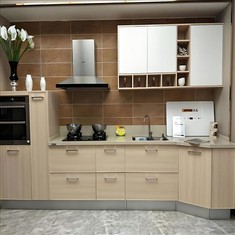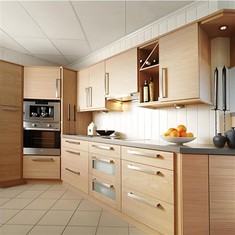


Wood Veneer Cabinets Kitchen
Color: White or customized
Material: Solid wood door,MDF,Plywood carcass,Particle Board
Size: Customized
Service: ODM/OEM
Description
Technical Parameters
Products Description
Inside materials: particle board/plywood/OSB board
Outer materials: particle board/MDF/plywood/OSB board/solid wood
Finish: PVC, UV, Lacquer, melamine, wood veneer, painting
Hardware: DTC or Blum
Main parts: pantry cabinets, island, base cabinets, wall cabinets
Size: customized per plan
Finish color: customized per interior design needs
Other cabinets: wardrobe, walk-in closet, bathroom vanity, TV cabinets, wine cabinets, home office cabinets, book shelf, laundry cabinet, pantry cabinets etc
Counter top: quartz, marble, grainte
Fuctional fittings: optional
Packing: Flat packing or unit cabinet sent assembled optional
wood veneer cabinets kitchen
Wood veneer kitchen cabinets are an excellent choice that offers a beautiful, high-end look at a more affordable price than solid wood. They strike a great balance between aesthetics, cost, and durability.

What Are Wood Veneer Cabinets?
- Construction: A thin slice of real, natural wood (the "veneer") is glued to a core material, which is usually a stable engineered wood like plywood, MDF, or particleboard.
- Key Point: The surface is 100% real wood with its natural grain, color, and texture. It is not a photograph or a print.
Think of it like a wood "wallpaper" on a very stable backing. This structure is actually more stable than solid wood, which can warp or crack with humidity changes.
Pros of Wood Veneer Cabinets
- Authentic Wood Look: Provides the beautiful, natural appearance of expensive hardwoods (like walnut, oak, or maple) at a fraction of the cost of solid wood.
- Cost-Effective: Significantly cheaper than solid wood cabinets, making high-end wood species more accessible.
- Dimensional Stability: The engineered wood core is less prone to warping, expanding, or contracting with changes in temperature and humidity compared to solid wood. This is a major advantage for kitchens.
- Eco-Friendly: A single log can produce a large amount of veneer, covering many cabinets, whereas solid wood requires much more lumber.
- Consistent Appearance: Allows for a uniform grain pattern across all doors, which can be difficult with solid wood due to natural variations.
Cons & Important Considerations
- Not as Easily Refinishable as Solid Wood: This is the biggest drawback.Sanding is risky because the veneer layer is thin. You can only sand it lightly once or twice at most before you risk sanding through it to the core underneath.Stripping and re-staining is a job for a professional, as mistakes can ruin the veneer.
- Can Be Vulnerable to Damage: The thin wood layer can be chipped, scratched, or delaminated (peel) if hit sharply. Moisture can also damage the edges if it seeps in.
- Edge Banding: The edges of the cabinets are covered with a strip of veneer or other material (called edge banding). If this becomes damaged, it can be difficult to repair seamlessly.
Veneer vs. Solid Wood vs. Laminate
|
Feature |
Wood Veneer |
Solid Wood |
Laminate |
|---|---|---|---|
|
Surface |
Real Wood |
Real Wood |
Plastic/Printed Layer |
|
Cost |
Mid-Range |
High-End |
Budget-Friendly |
|
Durability |
Good (can scratch) |
Excellent (can be refinished) |
Excellent (scratch-resistant) |
|
Moisture Resistance |
Fair (protect edges) |
Good (with finish) |
Excellent |
|
Can it be refinished? |
Limited (professional only) |
Yes, easily |
No |
Design Styles & Finishes
Wood veneer is incredibly versatile and works with many styles:
- Modern: Flat-panel (slab) doors in a light wood veneer like oak or maple.
- Mid-Century Modern: Rich, warm veneers like walnut are a hallmark of this style.
- Scandinavian: Light, natural wood tones like ash or light oak.
- Traditional: Veneers can be used on raised panel doors in species like cherry or mahogany.
Hot Tags: wood veneer cabinets kitchen, China wood veneer cabinets kitchen manufacturers, suppliers, Cabinet Wood Veneer, wood veneer cabinet, Wood Veneer Cabinet Doors, Wood Veneer Panels Cabinets
Send Inquiry