

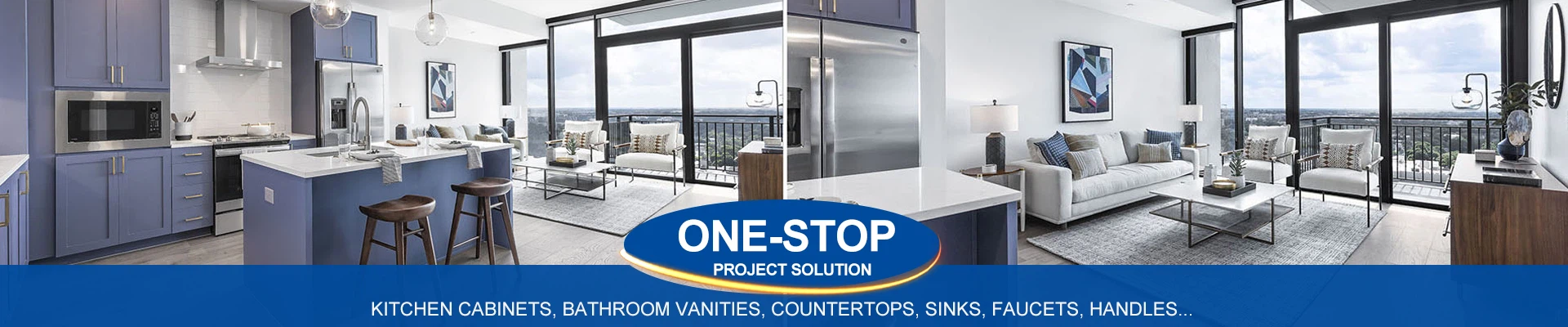
how can i change my kitchen cabinets
Jun 18, 2025
Leave a message
Transforming your kitchen cabinets can range from simple cosmetic updates to full replacements, depending on your budget, time, and goals. Here's a comprehensive breakdown of methods, steps, and considerations:
🎨 1. Refresh Without Replacement (Budget-Friendly)
A. Paint or Refinish
Steps:
Remove hardware/doors: Label doors/drawers for reassembly .
Clean & degrease: Use TSP substitute or soapy water to remove grime .
Sand surfaces: Lightly sand with 120–220-grit paper for paint adhesion .
Apply primer: Use adhesion-promoting primer (e.g., shellac-based for laminate) .
Paint: Use acrylic enamel or alkyd paint. Apply 2–3 thin coats with a foam roller for smoothness .
Add effects: Distress edges for a rustic look or apply glaze for depth .
Cost: 200–200–200–600 DIY; 3–7 days .
B. Upgrade Hardware
Replace knobs/pulls with modern designs (e.g., bronze, glass) for an instant style boost .
Tip: Use existing screw holes to avoid redrilling.
C. Partial Open Shelving
Convert some upper cabinets to open shelves for display. Pair with closed storage for clutter-free zones .
✨ 2. Refacing (Mid-Cost Update)
Update cabinet exteriors while keeping boxes intact:
Door Replacement: Install new shaker-style or glass-front doors .
Veneer Application: Adhere wood/laminate veneers to frames for a fresh look.
Add Crown Molding: Attach molding to the top of cabinets for a high-end finish .
Cost: 30–50% cheaper than full replacement .
🔨 3. Full Replacement (Structural Change)
A. Removal Process
Empty cabinets: Clear contents, shelves, and drawers.
Detach doors/hardware: Unscrew hinges and handles.
Locate mounting screws:
Upper cabinets: Unscrew from wall studs inside the cabinet.
Base cabinets: Remove toe kick plates; unscrew from wall/floor.
Lift out with assistance: Use support for heavy units to prevent damage.
B. Installation Steps
Prepare tools: Stud finder, level, drill, screws, shims.
Mark reference lines: Use a laser level for alignment (54" from floor for uppers).
Locate studs: Anchor all cabinets to wall studs-never just drywall .
Install uppers first:
Use a temporary ledger board for support.
Secure cabinets to studs with 3" screws; shim for uneven walls.
Attach base cabinets: Level and interconnect units for stability.
Add doors/hardware: Adjust hinges for smooth operation.
⚖️ 4. Key Decision Factors
| Factor | Refresh/Reface | Full Replacement |
|---|---|---|
| Cost | 200–200–200–1,500 | 3,000–3,000–3,000–20,000+ |
| Time | 3–7 days | 2–6 weeks (including ordering) |
| Effort | DIY-friendly | Professional recommended |
| Longevity | 5–10 years (with maintenance) | 15+ years |
| Best For | Intact frames; cosmetic updates | Structural damage; layout changes |
⚠️ 5. Critical Considerations
Cabinet Condition: Refacing only works if frames are structurally sound .
Weight Limits: Wall cabinets require stud anchoring (min. 2 screws/stud) .
Ventilation: Ensure airflow when painting/staining to avoid fumes .
Professional Help: Recommended for:
Gas/electrical adjustments during removal .
Countertop integration (install after cabinets) .
Complex layouts (e.g., islands, angled walls) .
💡 Pro Tips for Success
Test Colors: Sample paint on a cabinet back before full commitment .
Hardware Upgrades: Pair new handles with soft-close hinges for luxury feel .
Eco-Friendly Choice: Repurpose old cabinets as garage storage instead of trashing .
Hybrid Approach: Replace only lower cabinets for easier access; keep/refresh uppers .
💎 Conclusion
Changing kitchen cabinets hinges on budget, cabinet condition, and desired outcome. For quick refreshes, painting + hardware swaps deliver dramatic results . For layout upgrades or severe damage, full replacement ensures longevity . Always prioritize structural integrity-when in doubt, consult a professional to avoid costly errors.